Stoneflies Primer (Plecoptera): The Year-Round Coldwater Indicator Insect
Stoneflies (order Plecoptera) are the year-round inland trout food that anglers underestimate. Multiple species emerge across the SHA-region calendar from January black stones through October fall stoneflies. The nymph is consistently catchable; the adult is briefly emergent. The single best indicator of stream water-quality across the inland trout range.
TL;DR
What this primer covers
The stonefly order (Plecoptera) is one of the four major aquatic-insect orders SHA anglers should know -- alongside mayflies (Ephemeroptera), caddisflies (Trichoptera), and midges (Chironomidae). This article covers the categorical biology + the SHA-region species + the practical angler implications. See the hatch fundamentals for the broader framework.
Identification
Stoneflies are distinguishable from mayflies and caddis at both nymph + adult life stages:
Stonefly nymphs
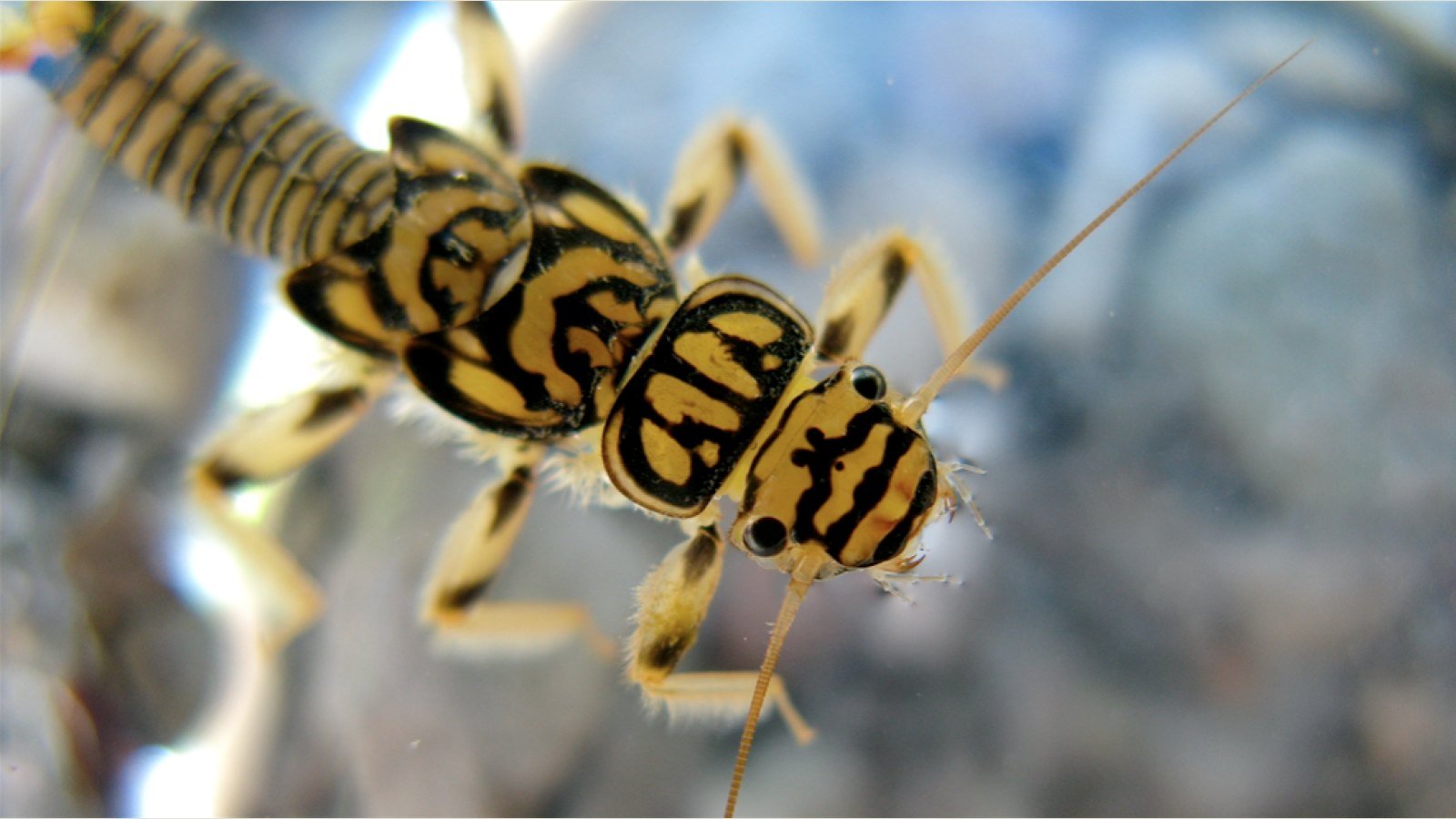
- Two tails -- diagnostic vs the three tails of most mayflies.
- Two wing pads on the back of the developing nymph.
- Two long antennae on the head.
- Stout, robust body with distinct head + thorax + abdomen segments.
- Strong legs ending in claws that grip rock substrate.
- Size range: tiny (size 18) winter blacks to large (size 4-6) salmonfly nymphs (more common west of the SHA range).
Stonefly adults
- Two pairs of wings held flat over the back (vs mayfly upright wings and caddis tent-shaped wings).
- Long antennae at the head.
- Two tails (cerci).
- Body color varies by species: black for winter stones; tan/golden for golden stones; yellow for yellow sallies.
- Weak fliers -- stoneflies flutter rather than fly; surface presentations + skating patterns work.
Life cycle
Stoneflies are hemimetabolous (incomplete metamorphosis) -- they go from egg through multiple nymph stages directly to adult without a pupal stage:
- Eggs deposited in stream substrate.
- Nymphs develop in stream substrate (rocks, gravel, debris) for 1-3 years depending on species. Crawl-active; do not swim.
- Emergence -- mature nymphs crawl OUT of the water onto rocks or bank vegetation, molt to adult form (vs aquatic mayfly + caddis emergence). This is the key behavioral difference: stoneflies emerge by crawling out, not by floating up through the water column.
- Adults mate above the water; females return to deposit eggs.
- Adult lifespan short (days to a week typically).
The crawl-out emergence affects fishing: stonefly adult patterns are most effective near banks + rocks, not over open water.
SHA-region stonefly species + timing
| Winter blacks (Capniidae) | Small black stoneflies emerging January-February in cold weather. Size 16-18. Surface fishing opportunity in winter. |
| Little browns (Nemouridae) | Spring emergence; March-April. Size 14-16. |
| Skwala (Perlodidae) | Early spring; March-April emergence. Size 10-12. Larger pre-spawn brown trout target. |
| Golden stones (Perlidae) | Late spring through early summer; May-July emergence depending on stream + elevation. Size 6-10. |
| Yellow sallies (Chloroperlidae) | Late spring + early summer. Size 12-16. |
| Various Pteronarcyidae (giant black stones) | Late spring + early summer; substantial nymph fishing. |
Tactics + patterns
Nymph fishing (year-round)
- Pattern sizes: 8-14 for most SHA-region work; size 6-8 for giant black stoneflies + early-spring skwala nymphs.
- Colors: black + brown + golden + olive matching the natural.
- Patterns: Pat's Rubber Legs + Tungsten Stonefly + Stonefly Bugger + Black Stonefly.
- Tactics: Czech nymph + Euro nymph + indicator-style dead-drift. Deep, slow, near-bottom.
- Best windows: winter + early spring when other forage is reduced.
Dry fly fishing (during emergence)
- Winter blacks: small black dry patterns (size 16-18) near banks on warm winter days.
- Yellow sallies + small spring stones: small yellow dries (size 12-16).
- Golden stones: mid-sized golden patterns (size 8-12).
- Skating presentations: stoneflies flutter when egg-laying; skating + twitching dry patterns can trigger trout strikes.
Indicator species value
Stoneflies require high dissolved oxygen + cold water + clean substrate to complete their 1-3 year nymph development. The species is intolerant of pollution; their presence in a stream indicates good water-quality conditions; their absence (where habitat suggests they should be present) indicates problems.
State agencies use stonefly presence as one component of stream-quality assessment. The angler can do the same -- if you turn over rocks in a stream and find stonefly nymphs, the watershed is doing its job; if you find none in apparently-suitable habitat, look at why.
Honest gaps
- No species-level identification of every SHA-region stonefly.
- No comprehensive timing data for individual watersheds.
- No coverage of Pacific salmonfly + western stonefly hatches (out of regional scope).
Full source list
- Tier 3 -- entomological reference: order Plecoptera biology + identification.
- Tier 1 -- state agency aquatic-insect references (PFBC + ODNR + NYSDEC).
- Tier 2 -- general fly-fishing entomology literature.
Common questions
When should I fish stonefly nymphs?
Any time. Stonefly nymphs are present year-round and are particularly productive in cold months (December-March) when other forage is reduced.
Are winter stoneflies actually fishable?
Yes -- on warm winter afternoons (40+ degF air temperature), small black winter stones emerge near banks and produce surface fishing on otherwise dormant streams. Niche but real.
How do I know if a stream has stoneflies?
Turn over rocks in riffle areas. Stonefly nymphs are large + visible + numerous in quality streams. The presence is unmistakable.
What's the biggest stonefly I'll see in SHA streams?
Giant black stoneflies (Pteronarcys) produce size 4-6 patterns at peak. Less common in SHA-region than western US streams but present.
Image credits and licensing
- Inline image: Stonefly nymphs signal clean, oxygenated water and a year-round nymphing food source. Photo: Dave Huth / Wikimedia Commons, CC BY 2.0.
- Hero image: Photo: Dave Huth / Wikimedia Commons, CC BY 2.0.